

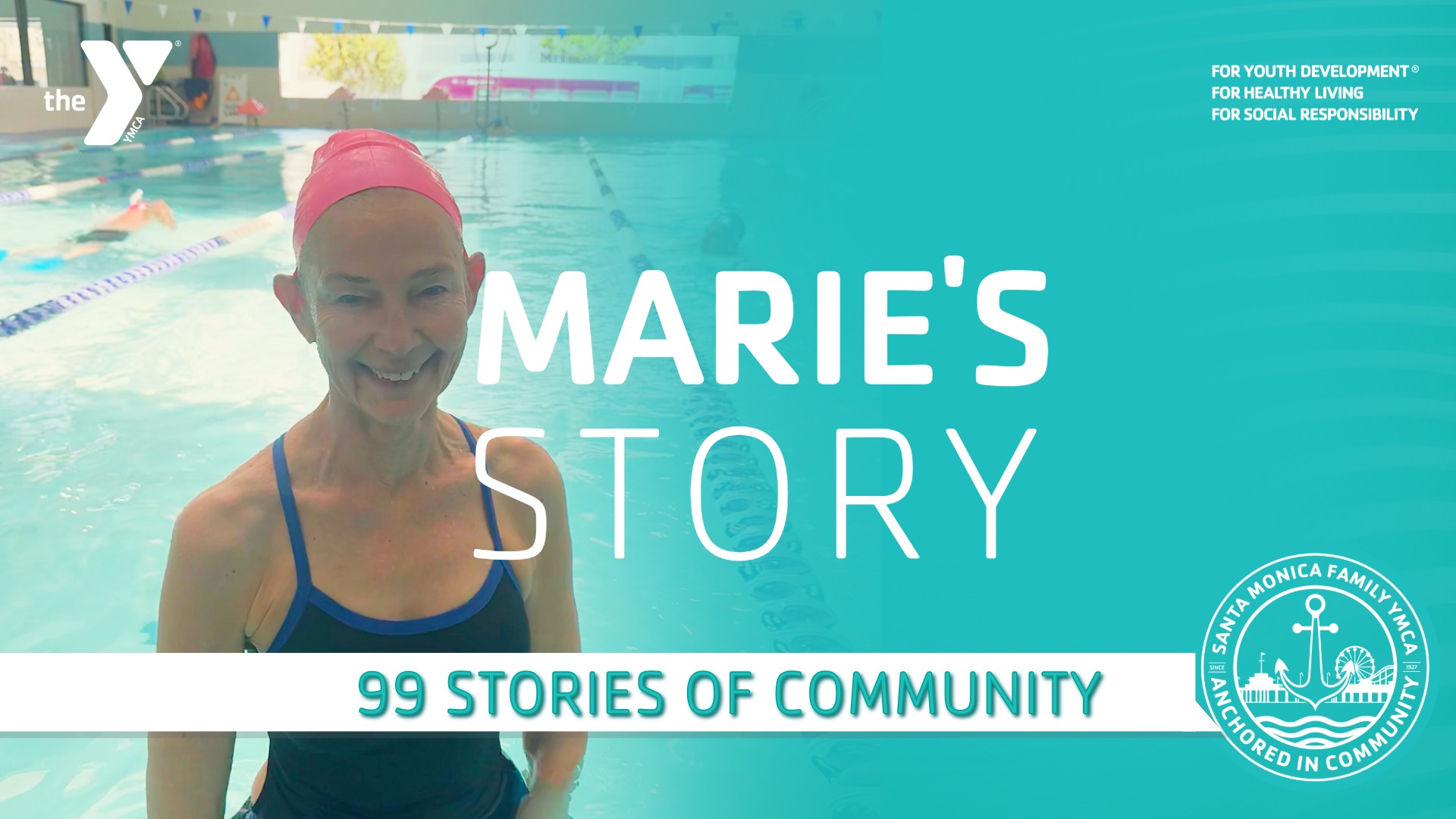
Marie’s Story
99 Stories of Community Series
Meet Marie, a YMCA Member for over 35 years and a Storyteller. Marie’s passion for the Y is defined by two things – the water and the community atmosphere. We sat down with Marie to hear her Y story, and we are pleased to invite you into the conversation.
Q: Can you share what you love most about swimming, Marie?
A: Well, this is almost philosophical, okay? And at this point in time, I really swim more from my head than anything else. It’s very nice to, you know, move your limbs and all that stuff, and breathe and feel like you’re one form merging with this other foreign form, which is water in the company of other people, which is very lovely. But the main thing I love about swimming, no matter what stroke you do, you are always moving forward. There is no, even if you do a backstroke, you are not moving back. You are you’re swimming more laps. You’ advancing your procedurals for the swim or the exercising. And I don’t stop. Once I start, I only stop if somebody wants to join me, I always wait and acknowledge and wave. Yeah, I see you. Got it. You’re in.
“The most profound thing about swimming… there is no backwards, it’s only forwards. And the only resistance is my determination to continue, as far as I’m concerned. And this, I find very affirming.”
So, but, but I think that’s the most profound thing about swimming. There is no backwards, it’s only forwards. And the only resistance is my determination to continue, as far as I’m concerned. And this, I find this very affirming. I just I love doing it, and I, you know, I I have come swimming when I had a job job and I had to show up at a certain hour and I had to make sure I could get to swim in before the out. But now I work for myself. I’m an entrepreneur of sorts. And I run my business from my house. So I just every day go, you have two hours. I give you these two hours to do your thing at the pool. And I don’t care if I wait for a lane. I don’t care who I swim with. I really don’t care. So I have two hours, and I just come here and I just go into swim zone. So it’s my head.
I love it when people go, “Oh, you’re fit.” I’m like, “No, no, I’m not fit.” I mean, maybe I’m fit, but mainly, I’m saying, I’m saying swimming keeps me sane and it really makes me happy. And I think those are the two cornerstones of any kind of house, whether it’s, okay, all right, if I break my leg, yes, I will go get it fixed. But my health is it’s not about my broken leg. It’s about my sanity and my happiness. And if the pool helps me do that, which it does is by God, I’m doing it every frickin’ day. You, why would I not? You know, it would be insane not to do it.
“Swimming keeps me sane and it makes me happy. And I think those are the two cornerstones of any kind of house… it’s about my sanity and my happiness. If the pool helps me do that… I’m doing it [everyday].”
So I just love, ” oh, you’re so disciplined.” No, I’m not. Trust me, trust me. I’m a procrastinator, but not when it comes to getting in the pool. This has really been my happiness. And I find swimmers to be excellent humans in general, you know? There is There are those of us who swim regularly. And it’s so, I love seeing them, ‘Stephen, how are you doing?’ You know, it’s just great.
Q: After so many years being involved with the YMCA, what does community mean to you now?
A: Well, you know, community’s always a about shared interests. You know, it’s very difficult to have community with people who have no interest in what you’re doing. That’s a problem. And so I walk into the pool, and everybody’s my friend, you know? That’s my attitude, you know? Like, ‘She’s here, she’s swimming, she’s slow. We don’t care! Let her in!’, you know.
What can I say? That’s really it, it’s that simple. Shared interests make for really good community. And I think that sometimes in a workout facility like this, people are told that they should do this in order to achieve this. And so they come here out of duty or some other, you, gnarly thing, like, ‘Oh, my doctor says I have to’, or ‘My sister is on my case’, or ‘If I can’t fit into these pants before the wedding, I’m really depressed.’ And I don’t think those people last unless they find their own cause. If you don’t find your own reason to be here, you will never show up consistently, you just won’t.
You know, there’s some very nice ladies that come for water aerobics (we always call them the bouncy ladies). Sometimes they have a teacher, sometimes they don’t. They all, they give them two lanes or sometimes three, depending on how many people are there, and they all get in there. And the teachers have a program. You know, they make them raise their arms a number of times, you know, whatever they I don’t track it. But I know that for them, like, it’s a gab fest. Man, I mean, they exercise, they move, they really do for that hour, but they talk. It It’s a social thing, and the schedule of Monday, Wednesday, Fridays, I know is very helpful because they want to come and see, I don’t know, Janie, or find out how Susan’s husband’s doing after the surgery or whatever. And I think that’s, I think that’s really wonderful. And I know a facility like this can do that.
I mean, for me, the swimming is free form. I come when I come. But I’m the kind of person, I never liked the schedule. You know? I mean, I like working. I like work, and I like people, and I really like doing stuff, and I don’t think of myself as lazy, but I like it to be on my timeline, you know? And so I love it that I don’t have to show up at 11 to take the class. Like, okay, these people that do the exercise class. I look in, and they’re, you know, they’re beautiful pink, you know, exercise clothes, marching in sequins, and I thought, not me. That is not me. And this is why the pool is great. It’s really good for people who do not like to be told what to do. And that goes on my poster, you know, but it is really good because you get to be part of a community, but you really get to do it your way. And I mean, that’s one of the great pleasures, finding community with who you share lanes with.
“You get to be a part of a community, but you really get to do it your way. And I mean, that’s one of the great pleasures … finding community with who you share lanes with.”
Q: So Marie, it sounds like you’ve been an avid swimmer so much of your life. When and how did you know how to swim?
A: I learned how to swim and I grew up in Texas. So I had lessons with a guy who I still remember his name, Juan Campos. He was fantastic. He was the lifeguard at the pool, and he taught swimming lessons, and he taught my brother and sister and I and lots of other kids how to swim. He was so great. And I still remember things he taught me, like when I do the backstroke. So that was so I learned to swim very early. Then I totally checked out from swimming and went to college.
When I went to graduate school, I thought I just thought, this is making me nuts. I got to have something else to do. So I literally, I was in San Francisco, and I figured out, I was very close to, like a, it was in, it was in Chinatown, and I was not too far from Chinatown. It San Francisco. And I could walk down a hillside street to a recreational facility in the heart of Chinatown and I could pay $2 and go swim and I would go there and everything that troubled me about my postgraduate work disappeared. I was just at the pool. I came back into the swimming thing just for distraction that kind of turned into something that I just loved. I loved going, I looked forward to going to the pool and going where nothing, nothing of the world was my weighted me down. And then the water also makes you feel so buoyant. You know, you get in the water and you’re like, no obstacles. Poof, no obstacles! I love this.
During the pandemic, I thought, ‘I’m gonna die without a pool.’ I can’t tell you how happy I was when Armand – let me speak his name, the god, the god of lifeguards! – he literally would show up here when you weren’t even sure about how many people could be in the locker room, but you could come and swim and go away. And Armand kept this pool open, he showed up to be the lifeguard when no one else would come. It just, I can’t tell you what that meant to me, that this facility was open again. Everyone needed to have a place to come and not be grief-stricken and pressured, and to feel like you could accomplish things you wanted to accomplish. Movement is a fantastic answer to the feeling of being powerless. So that’s another reason to swim.
“Movement is a fantastic answer to the feeling of being powerless. So, that’s another reason to swim.”
Q: What makes the YMCA special to you, Marie?
A: I just find that at YMCAs, people are more authentic. Sometimes the spa gets a little exclusive, because we’re paying more to get in here or we need to be treated differently. The great thing about the Y, it’s like, ‘everybody, come on, carnival!’ We’re all in this together and I like that. I want to be part of that kind of energy on the planet, so naturally, I’m going to be in a YMCA. When we go on vacation, I find a YMCA to go swim at. In Maine, Alabama, Missouri, New York… all over.
“We’re all in this together, and I like that. I want to be part of that kind of energy on the planet, so naturally, I’m going to be in a YMCA.”
What I love about the YMCA is that we can acknowledge that we all have different gifts, okay? Some people are smarter, some people are stronger, some people are faster, but we are all equal here. And I want to go to places where that’s the feeling. And I find that very consistently in YMCA.
Q: What would you say to someone who’s thinking about starting to swim? What would be your advice to them?
A: First of all, don’t go in expecting to accomplish things immediately. Just go in and see if you like being in the water. Come and don’t compare yourself to other people, see if you like being in the water and then make yourself swim a lap.
If you know how to swim, I would say the first thing you’ve got to do is you want to explore the possibility. You’ve got to take lessons. You’ve got to sign up. You cannot do this without knowing how to swim. And the guards are really good about helping new swimmers, ask people to move to the lane by the wall in case you. You can’t expect yourself if you’ve had no information about swimming to come to the pool and like figure it out.
Then part two is then make a plan, promise yourself you’re going to come three times a week. And and give yourself a timeframe, and the see if you want it. See if you find something you like doing. When you pass that hurdle, then decide that you’re going to set a time to swim nonstop. Give yourself a timeline to evolve your interest, because it does not just descend unless you are like that little baby that’s going to the pool that’s six months old, going to the pool for the first time, it takes time to love the water sometimes.
I see children go into the water, and some of them want to stay for a long time. And some of them scream before they go in, while they are in, and after they are in. It is not their deal. And while I think it’s important to teach children how to swim, particularly in L.A., where everyone has a pool and/or you’re near an ocean, I get it’s not for all people, and you may not be a swimmer. That’s okay. But you won’t know as an adult unless you consistently put yourself in the water and give yourself some training to help you understand how to move through the water. So that would be my encouragement. And I think that in terms of community, community, again, my core thing, it’s generated by shared interest. If you like the water, I promise you, hang out in a pool, you’ll find people who like the water, like you do. It’s, you know, I mean, I can’t tell you how many my conversations at the YMCA about the pool.
I really, I believe in swimming. I mean, I like the commitment of swimming. And I love this Y and this pool.
Thank you to Marie for sharing your story, your passion for swimming, and for being a part of our YMCA community! Your story of finding mental clarity and community in the water is inspiring.
This year, we will be sharing ninety-nine stories of impact this year through our Anchored in Community celebration, lifting up stories of our community members as we celebrate the Santa Monica Family YMCA’s 99th year of consistent service. Collected from our volunteers, members, program participants, to our community partners, we will be sharing stories that remind us what is possible when you anchor yourself in community, something you can always find at the Y. If you are interested in sharing your YMCA story and being a part of the 99 Stories of Community series, please fill out this form!
We invite you to follow along as we share these stories of impact, belonging, and purpose. Thank you for being a part of our community!
